Volume Control Precision:
Integral linearity (deviation from straight line) – better than 0.1dB
Differential linearity (step size) – better than 0.08dB
Digital Inputs: (SF = Sample Frequency)
XLR- accepts AES/EBU or SPDIF/ IEC 60958 type II formats with SF’s between 32 and 200 kHz
RCA- accepts AES/EBU or SPDIF/ IEC 60958 type II formats with SF’s between 32 and 200 kHz
Opt- accepts AES/EBU or SPDIF/ IEC 60958 type II formats with SF’s between 32 and 96 kHz*
USB- accepts inputs using native OS drivers with SF’s between 44.1 and 96 kHz
* The optical input is not recommended for inputs with SF’s higher than 96 kHz)
Analog Outputs:
The Volume setting controls both the rear panel XLR Line and front panel Headphone outputs.
Line Output – Rear panel balanced XLR. Front panel configurable for unbalanced operation with the included XLR to RCA adapters for connection using “standard” RCA to RCA cables.
Headphone Output- Front Panel Stereo ¼” Jack (Line output muting via front panel setting).
THD+N at max volume (volume = 56) – typical, 0.0008% FS, maximum 0.0013% FS
Test conditions: 20Hz – 20KHz, -3dBFS sine wave, 22-22KHz BW
At all possible settings and switch combinations. This also applies to operating the DA11 with the included XLR to RCA adapters.
Dynamic Range: -112dB typical, -110 dB minimum
Test conditions: Non weighted
At all possible settings and switch combinations.
Drive Capability:
24dBu Balanced XLR output into 1K ohms at Volume = 56 or lower
21dBu Balanced XLR output into 600 ohms at Volume = 53 or lower
18dBu Unbalanced XLR output into 600 ohms at Volume = 56 or lower
18dBu Headphone into 100 ohms at Volume = 56 or lower *
18dBu Headphone into 50 ohms at Volume = 50 or lower *
AC Power:
Voltage 90-264 VAC, Frequency 40-63Hz,
Typical Current usage: 0.1A
Fuse Rating 2.5A “Time Delay” *
Dimensions:
8”w x 1.75”h x 10.75” d (including front panel switches and rear panel connectors)
 音響足跡
音響足跡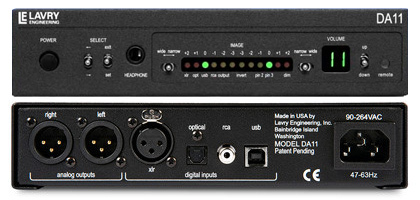


 二手價格
二手價格